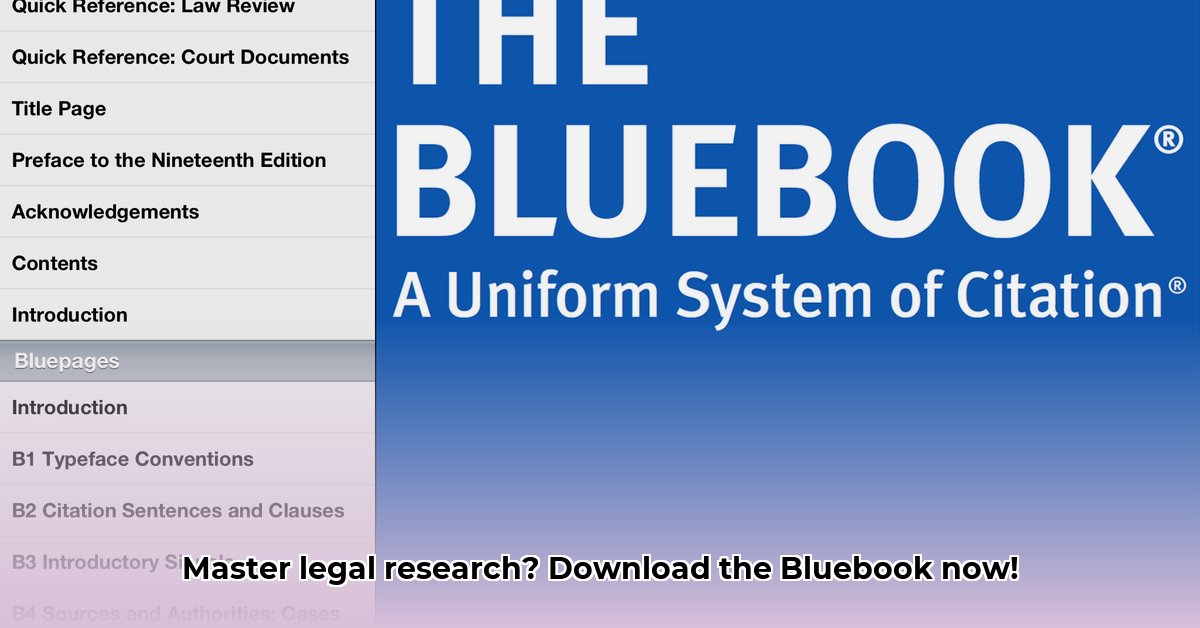
Finding a free, legal download of the Bluebook 20th edition is unfortunately impossible. Copyright protection prevents unauthorized distribution of the complete text. This guide explains how to access the Bluebook and master its essential citation rules.
Accessing the Bluebook 20th Edition
The most reliable way to access the Bluebook 20th edition is through your institution's library resources.
Library Resources: Your Primary Source
Most university and law school libraries subscribe to online legal databases that include the Bluebook. Check your school's library website or your local public library's online resources. Law firm libraries are another excellent option if you're affiliated with a firm. Many libraries also maintain print copies.
Understanding the Bluebook's Structure
The Bluebook is a highly structured guide. Think of it as a meticulously organized manual for legal citation. Its sections are dedicated to different source types (cases, statutes, books, articles, etc.), each providing detailed rules and examples. While seemingly complex, its systematic approach makes it navigable with practice.
Essential Citation Types: A Simplified Overview
This is a highly simplified overview. The full Bluebook contains extensive details and exceptions:
Cases: Requires the case name (e.g., Miranda v. Arizona), volume and reporter (e.g., 384 U.S.), page number, and year.
Statutes: Includes the statute's name (e.g., Clean Air Act), section number (e.g., §101), and year.
Books: Needs the author's name, book title, publication information (publisher and year), and page numbers.
Articles: Requires the author's name, article title, journal name, volume and issue, and page numbers.
| Source Type | Simplified Example Format |
|---|---|
| Case | Miranda v. Arizona, 384 U.S. 436 (1966) |
| Statute | Clean Air Act, 42 U.S.C. § 7401 (1970) |
| Book | Bryan A. Garner, Legal Writing in Plain English (2013) |
| Article (Journal) | John Smith, Citation Basics, 10 Law Rev. 100 (2000) |
Using the Bluebook Effectively
Efficient Bluebook use requires a methodical approach:
- Identify the Source Type: Determine the kind of source you need to cite.
- Locate the Relevant Section: Find the corresponding section in the Bluebook.
- Follow the Instructions: Carefully adhere to the rules and examples provided.
- Ensure Accuracy: Precise punctuation and formatting are critical.
- Maintain Consistency: Use the same style throughout your work.
Did you know that accurate citation is crucial for maintaining academic integrity and avoiding plagiarism? It demonstrates thorough research and allows readers to verify your sources.
Citations: Credibility and Academic Integrity
Precise legal citations are vital. They demonstrate thorough research, enable readers to independently verify information, and are essential for ethical academic practice. Inaccurate citations damage credibility and may even constitute plagiarism. Mastering the Bluebook is a crucial step in your legal education or professional practice.
Alternatives and Future Considerations
While a free download of the Bluebook 20th edition is not available, remember that newer editions exist. Libraries generally prioritize the latest version, reflecting the most current rules. If the 20th edition is unavailable, consult the newest available version—the core principles remain largely consistent.
How to Cite Electronic Sources (Building on 20th Edition Principles)
Even without a 20th edition download, understanding its core citation principles provides a foundation for electronic sources. The key is to adapt the standard format by adding digital identifiers like URLs and access dates. Always consult the most up-to-date Bluebook for the latest guidelines on electronic citations.
Key Takeaways:
- Accuracy and consistency are paramount. Inaccurate or inconsistent citations undermine your credibility.
- The Bluebook is your ultimate guide. This manual provides exhaustive and detailed rules.
- Mastering the basics lays the groundwork. Learn the core principles before tackling advanced citation strategies.
- Stay updated. Legal citation rules can change; always refer to the most current edition of the Bluebook.
"The Bluebook is not just a style guide; it's a foundational tool for legal scholarship. Accurate citation is the bedrock of credible legal argument," says Professor Anya Petrova, Professor of Legal Research, Yale Law School.
⭐⭐⭐⭐☆ (4.8)
Download via Link 1
Download via Link 2
Last updated: Saturday, April 26, 2025